
Understanding Electromagnetic Fields, Human Exposure, and Measurement Standards
A Comprehensive Guide to EMF Standards and Measurement Solutions
Electromagnetic fields are an integral part of our daily lives. From household appliances to telecommunications infrastructure, EMF exposure occurs constantly in modern environments. The challenge, however, is that electromagnetic fields cannot be seen, felt, or detected without specialized equipment. This is why understanding what electromagnetic fields are, how they interact with the human body, how to measure them accurately, and which standards apply to each situation is essential for occupational health, workplace safety, and public wellness.
With over 29 years of expertise in EMF safety and measurement solutions, Wavecontrol has delivered more than 20.000 instruments across 80+ countries, supporting the transformation of invisible fields into measurable, manageable data.
What Are Electromagnetic Fields?
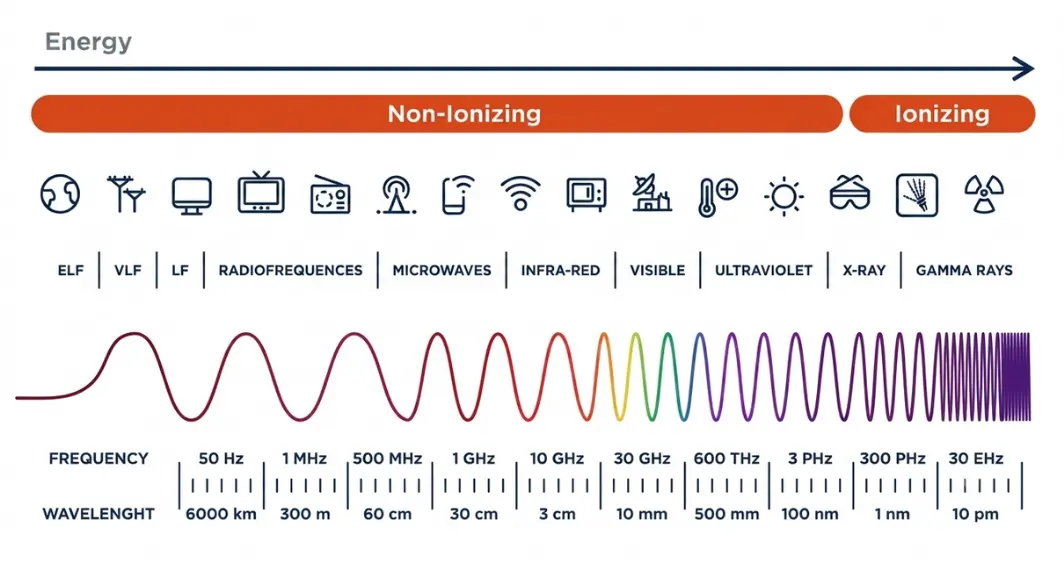
Electromagnetic waves are synchronized oscillations of electric and magnetic fields. These invisible forms of energy travel at the speed of light and are generated by both natural phenomena and human-made sources, including electrical systems and wireless technologies.
EMF can be classified into two main categories:
- Ionizing radiation, like UV, X-rays, and gamma rays, which possess enough energy to alter molecules and DNA.
- Non-ionizing radiation, primary focus of this article, does not have enough energy to ionize atoms or molecules. Its effects are generally limited to induced currents or heating at higher exposure levels.
Since these invisible fields are part of many everyday and workplace environments, an obvious question follows: how do they interact with the human body? The answer depends mainly on the frequency and intensity of the field.
Health Effects: What Science Shows
At different frequencies, electromagnetic fields interact with the body in different ways. At lower frequencies (1 Hz to 10 MHz), electromagnetic fields can induce electric fields and currents within the body, resulting in established effects such as nerve and muscle stimulation. At higher frequencies (100 kHz to 300 GHz), the primary established effect is tissue heating caused by energy absorption. These effects have been extensively studied and form the scientific basis for today’s EMF exposure guidelines and safety standards.
Recognizing the potential health impacts of electromagnetic field exposure, regulatory bodies worldwide have established exposure limits based on this scientific evidence. These limits are not universal; they vary by country, industry, and whether workers are trained professionals or members of the general public. Understanding these standards is essential; effective compliance requires identifying the applicable requirements for each context.
International EMF Standards and Exposure Limits
EMF exposure limits vary by standard, region and application. Key international guidelines include:
- ICNIRP Guidelines (1998, 2010 and 2020): Widely adopted internationally, covering 0 Hz to 300 GHz. The 2020 update shifts high-frequency wholebody averaging time from 6 minutes to 30 minutes for whole-body exposure. The 2010 guideline covers the entire low frequency range (1 Hz to 10 MHz).
- IEEE C95.1: Used in North America and multiple countries, covering 0 Hz to 300 GHz with 30-minute averaging for high frequencies.
- Safety Code 6 (Health Canada): Covering 3 kHz to 300 GHz with 6-minute averaging up to 15 GHz.
- EU Directives (1999 recommendation and 2013 directive): Used across EU member states and the UK (adapted as CEMFAW), aligned with ICNIRP limits.
Occupational exposure limits are typically higher than those for the general public, reflecting the controlled nature of workplace environments and the training provided to workers.
Beyond regional differences, EMF assessment requirements can also vary significantly between industries. Different applications generate electromagnetic fields across different frequency ranges and exposure conditions, creating unique measurement and compliance challenges that require tailored assessment approaches.
Applications Where EMF Measurement is Essential
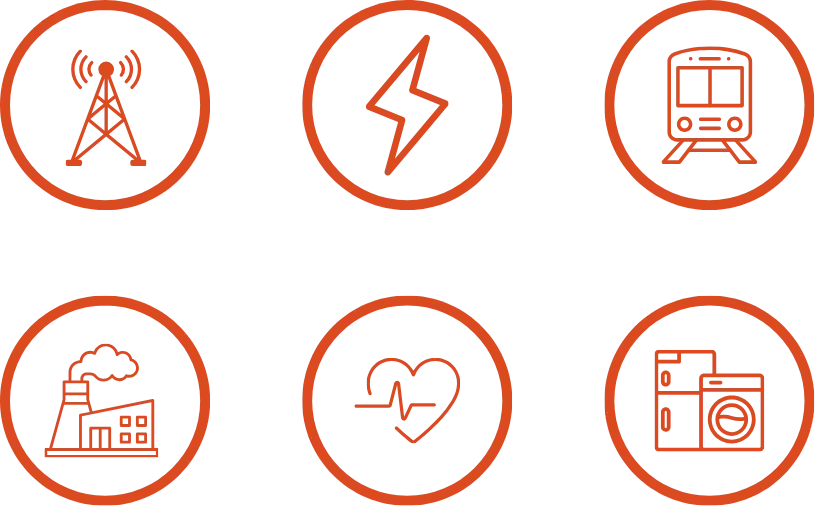
EMF assessment is needed across diverse sectors:
- Telecommunications and Broadcasting: Evaluating RF exposure at base stations and broadcast facilities using standards such as IEC 62232.
- Power Systems: Assessing magnetic field exposure at substations, power lines, and underground cables per IEC 62110 and IEC 61786.
- Railway: Measuring magnetic fields from rolling stock and infrastructure up to 20 kHz per EN 50500 and IEC 62597.
- Industrial Applications: Covering welding, induction heating, and semiconductor production across multiple frequency ranges.
- Medical Facilities: Assessing exposure from MRI devices, electrosurgery, and diathermy equipment per IEC 60601 standards.
- Household Safety: Measuring emissions from appliances, induction cooktops, and other consumer devices per IEC 62233.
Accurate Measurement: The Foundation of EMF Assessment
The scope of the challenge is clear: EMF is everywhere, standards are diverse, and exposure scenarios are complex. Accurate measurement is fundamental to effective EMF assessment and compliance. However, measurement is more than recording instrument readings. It requires understanding frequency ranges, selecting appropriate instruments, and interpreting results correctly.
Accurate measurement is the foundation of any effective EMF assessment program. Selecting the right instrument requires understanding the frequency range, exposure scenario, and applicable standards for a given application.
Proper EMF measurement requires instruments that cover the complete frequency range relevant to each application. Solutions must account for overlapping frequency bands where both electrostimulation and thermal effects occur, particularly between 100 kHz and 10 MHz.
Measurement instruments may offer both selective probes for detailed frequency analysis and broadband probes for comprehensive field assessment. Selective probes enable FFT analysis and detailed examination of specific frequency contributions, while broadband probes provide rapid, complete exposure assessment across wide frequency ranges up to 90 GHz.
Wavecontrol’s Comprehensive EMF Solutions
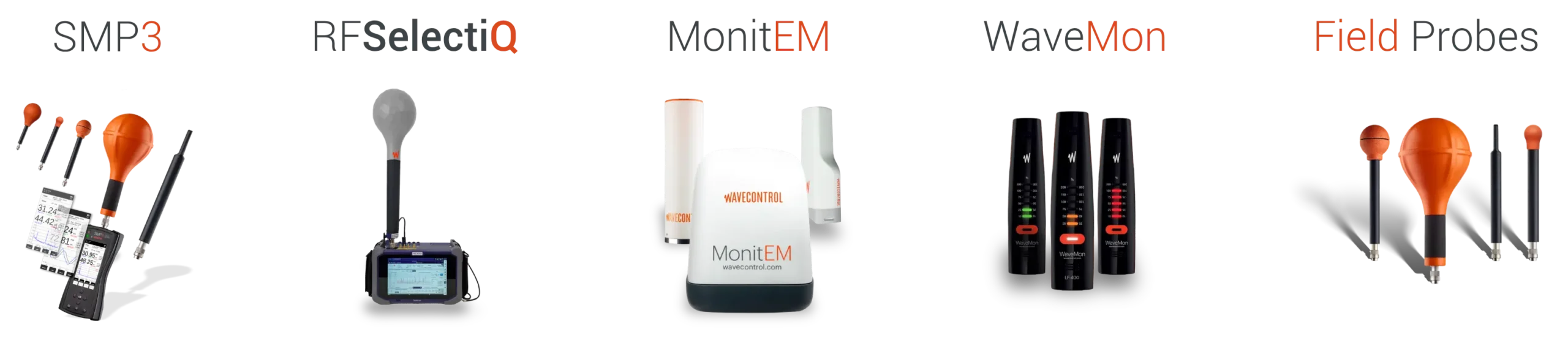
Meeting these diverse measurement requirements demands a combination of versatile instruments, specialized probes, and continuous monitoring solutions. Wavecontrol provides:
- SMP3 Meter: A portable advanced EMF meter with extensive standard limits, capable of measuring both low-frequency and high-frequency fields with selective and broadband probes.
- RF Spectrum Analyzer (RFSelectiQ): An advanced EMF analyzer with selective-code and traffic-analysis capabilities for detailed frequency domain assessment. Covers up to 44 GHz with optional GPS, enabling in-depth RF exposure investigations and precise extrapolation without operator parameters; particularly valuable for complex multi-band scenarios and 5G compliance assessment.
- Area Monitors (MonitEM series): Designed for continuous monitoring, both indoors and outdoors, in research labs, manufacturing plants, and production environments to support exposure monitoring in occupational environments.
- Personal Warning Monitors (WaveMon series): Wearable warning devices for low-frequency and RF exposure assessment in diverse applications.
- Specialized Probes: From DC field probes to broadband RF probes covering 0 Hz to 90 GHz, with options for selective measurements and high-power applications.
Whether you need portable surveys, continuous area monitoring, personal exposure assessment, or highly specialized measurements, Wavecontrol offers a complete ecosystem of instruments designed to support EMF safety, compliance, and research across any industry.
Supporting Effective EMF Management
Effective EMF management starts with understanding potential exposure sources, applying the appropriate standards, and using reliable measurement tools. Whether your organization operates in telecommunications, manufacturing, healthcare, transportation, energy, or research, accurate EMF assessment is essential for evaluating exposure, verifying compliance with applicable standards, and supporting informed risk-management decisions.
With nearly three decades of expertise and a comprehensive portfolio covering frequencies from 0 Hz to 90 GHz, Wavecontrol helps organizations confidently address even the most demanding EMF measurement challenges.
Ready to evaluate your EMF environment? Contact Wavecontrol’s experts to discuss your application, identify the right measurement solution, and support your EMF assessment and compliance objectives.
Article-related FAQ
Which devices pose the greatest EMF exposure risk?
Any equipment generating significant electromagnetic fields, particularly when users are in close proximity, can present exposure concerns. This includes welding equipment, microwave ovens, high-voltage power lines, induction cooktops, and MRI devices. Risk depends on field strength and distance from the source.
What's the difference between selective and broadband probes?
Selective probes allow detailed frequency analysis up to 10 MHz using FFT analysis, enabling identification of specific frequency contributions. Broadband probes (up to 90 GHz) provide rapid assessment of total exposure from all sources without post-processing, simplifying field evaluation and compliance determination.
Are occupational EMF limits different from public limits?
Yes. Occupational limits apply to trained workers in controlled environments and are typically higher than general public limits. General public limits include additional safety margins to account for individuals of all ages and health conditions.

Project supported by ACCIÓ"s International Promotion Programme

Follow