
Three Levels of EMF Risk Assessment for AIMD Users
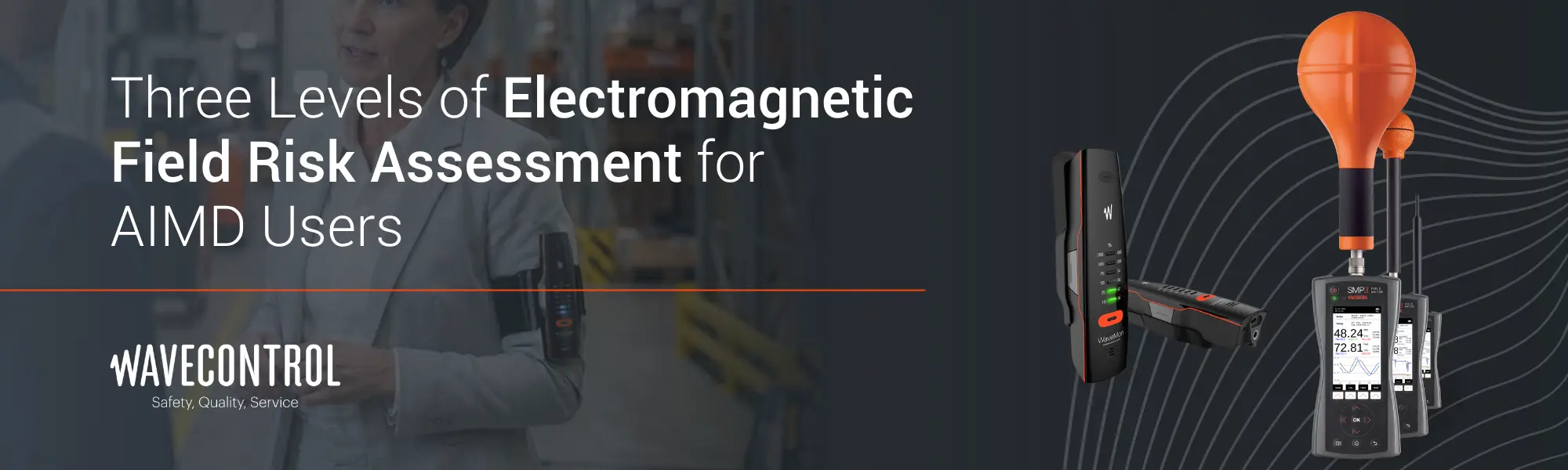
Electromagnetic fields are present in many environments, from industrial installations to everyday infrastructure. For individuals with active implanted medical devices (AIMD), such as pacemakers, exposure to these fields requires careful evaluation. EMF risk assessment for AIMD users involves identifying potential interference scenarios and applying appropriate assessment procedures. Performing these evaluations requires suitable EMF instrumentation capable of covering static, low frequency and RF exposure environments associated with AIMD applications. This article presents a structured approach based on three levels of risk assessment, explaining how to analyze electromagnetic exposure, how to interpret limits, and how to apply practical measures to reduce potential interference risks using Wavecontrol solutions.
Level 1: General EMF assessment and exposure control
The first level of EMF risk assessment focuses on evaluating electromagnetic field exposure in an environment. This first step applies to all individuals, not only those using active implanted medical devices.
The process starts with a site analysis. This involves identifying all electromagnetic field sources and understanding their characteristics, such as frequency range, field type, and operating conditions. It also includes evaluating proximity to sources and exposure duration.
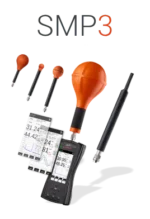
Once the environment is defined, measurements are performed using appropriate instrumentation. A portable EMF meter, like Wavecontrol’s SMP3, is typically used to assess field levels across static fields, low frequency and RF exposure environments using different probes adapted to the application. Measurements should be carried out under normal operating conditions, and also considering worst-case scenarios, such as equipment operating at maximum power.
Based on the results, exposure levels are compared with reference limits. These may include general public limits and device-related thresholds. Even if comparison with general public limits is the general benchmarking method for pacemakers, it is important to note that compliance with general public limits does not necessarily guarantee safety for users of implanted medical devices. General EMF limits are designed to prevent biological effects in humans, but not necessarily to ensure electromagnetic compatibility with implanted devices. As a result, interference may still occur below these limits.
Practical actions at this level include:
- Defining restriction zones based on measured field levels
- Marking these zones using physical indicators such as signs or floor markings
- Documenting measurements, conditions, and uncertainties
This level provides a baseline understanding of exposure and supports initial risk management decisions.
Level 2: Manufacturer and physician guidance
The second level of risk assessment introduces device-specific considerations. Active implanted medical devices are configured according to individual medical needs, which means their response to electromagnetic fields can vary between users.
Manufacturers provide guidance on how devices behave in the presence of electromagnetic fields. This includes recommended safety distances from certain types of equipment, as well as information about environments or devices that may cause interference. In some cases, manufacturers also define threshold levels that are more restrictive than general exposure limits.
Physicians also play a key role in this level of risk management. They consider:
- The specific type of implanted device
- Device configuration and sensitivity
- The individual’s medical condition
- Daily activities and exposure scenarios
Based on this information, they may recommend precautions, workplace adaptations, or specific evaluation procedures. They may also advise on actions to take if symptoms occur in environments with electromagnetic exposure.
This level ensures that risk management is adapted to the individual, rather than relying solely on general limits.
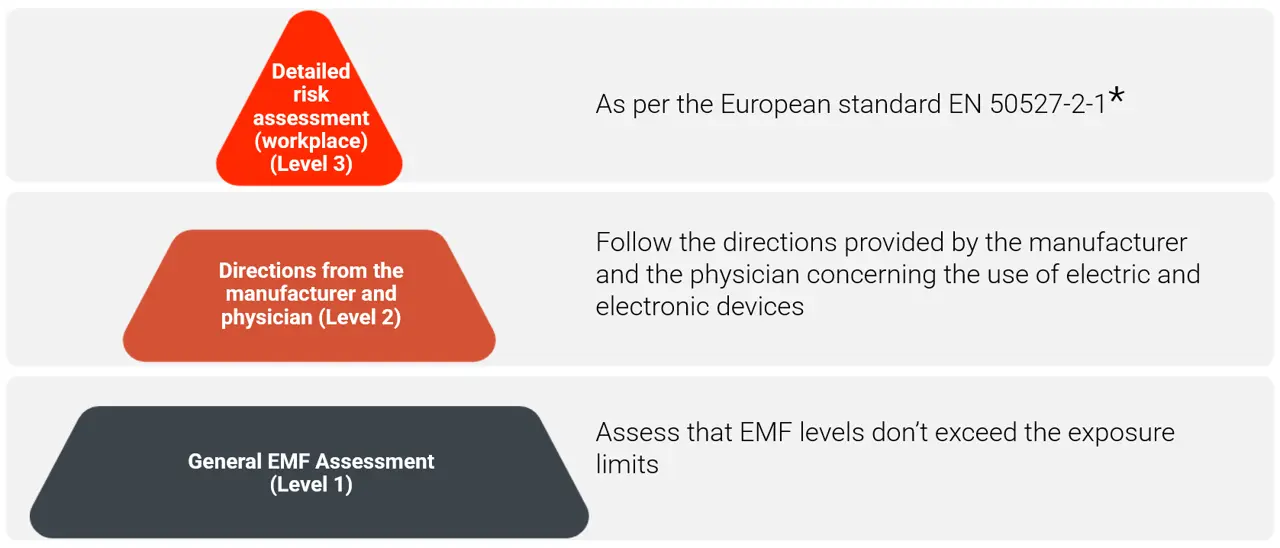
Level 3: Detailed risk assessment in complex environments
The third level applies to situations where uncertainty remains after general assessment and guidance have been considered. This typically occurs in complex environments or when specific conditions require further evaluation.
Detailed risk assessment may be necessary when:
- There is prior evidence or suspicion of interference
- Equipment is not covered by standard compliance assumptions
- Manufacturer or physician guidance indicates increased sensitivity
- Workplace conditions are not fully characterized
Two types of approaches are described.
- Clinical methods involve evaluating device behaviour under controlled conditions, with the individual present, and under supervision. This allows direct observation of device response to representative electromagnetic exposure.
- Non-clinical methods include laboratory-based testing or analytical approaches. These may involve exposing a device to representative fields in controlled setups, or estimating induced effects based on known parameters, such as field levels and device characteristics.
These approaches aim to provide a higher level of certainty when standard assessment methods are not sufficient. They are particularly relevant in environments where field conditions are complex or variable.
Supporting tools: measurement and monitoring
Across all three levels, measurement and monitoring tools support the assessment process.
Portable EMF meters, like Wavecontrol’s SMP3, are used to perform site surveys and quantify exposure levels across a wide frequency range. They support comparison with limits and help identify areas where additional precautions may be required.
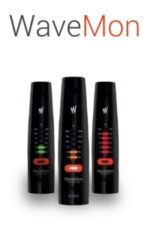
Personal monitoring devices, such as the WaveMon LF-400, can complement EMF assessment workflows by providing real-time alerts when predefined field thresholds are exceeded. However, these tools have limitations and should be used with caution.
Important considerations include:
- Personal monitors do not replace detailed site assessment
- They do not prevent exposure, but only provide early warnings
- They typically follow general exposure limits, which may differ from device-specific thresholds
For this reason, personal monitors should be configured based on manufacturer recommendations when used by implanted device users.
Suggested EMF Assessment Workflow for AIMD Users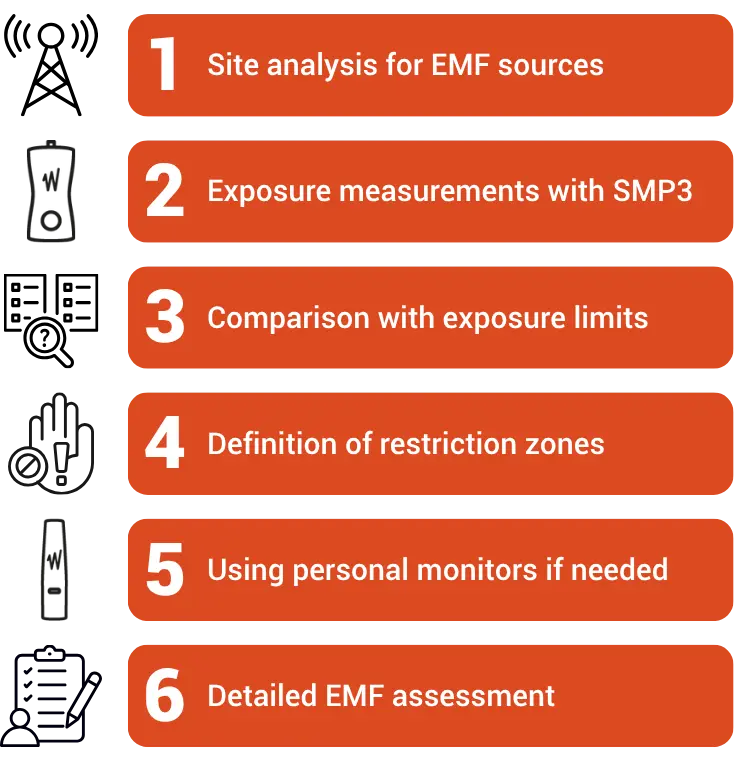
- Site analysis and identification of EMF sources.
- Exposure measurements using portable broadband EMF instrumentation such as the SMP3.
- Comparison with applicable exposure limits and AIMD-specific thresholds.
- Definition of restriction zones when required.
- Using personal monitoring devices such as the WaveMon when additional awareness is needed.
- Detailed assessment in complex environments.
Conclusion
EMF risk assessment for AIMD users relies on a structured and progressive approach. General assessment provides a first understanding of exposure, while manufacturer and physician guidance allows adaptation to individual conditions. In complex situations, detailed assessment methods offer additional confidence. Applying these three levels helps manage uncertainty and supports informed decisions regarding electromagnetic exposure in environments where AIMD users are present.
If you would like to explore how these solutions can be tailored to your specific needs, contact one of our experts.

Download the Application Note: EMF Risk Assessment for Users of Active Implantable Medical Devices (AIMDs)
This application note shows a detailed step-by-step process on how to perform EMF risk assessment for users of Active Implatable Medical Devices (AIMDs), such as pacemakers.

Project supported by ACCIÓ"s International Promotion Programme

Follow