
Measuring Electromagnetic Fields with the SMP3: Real Applications
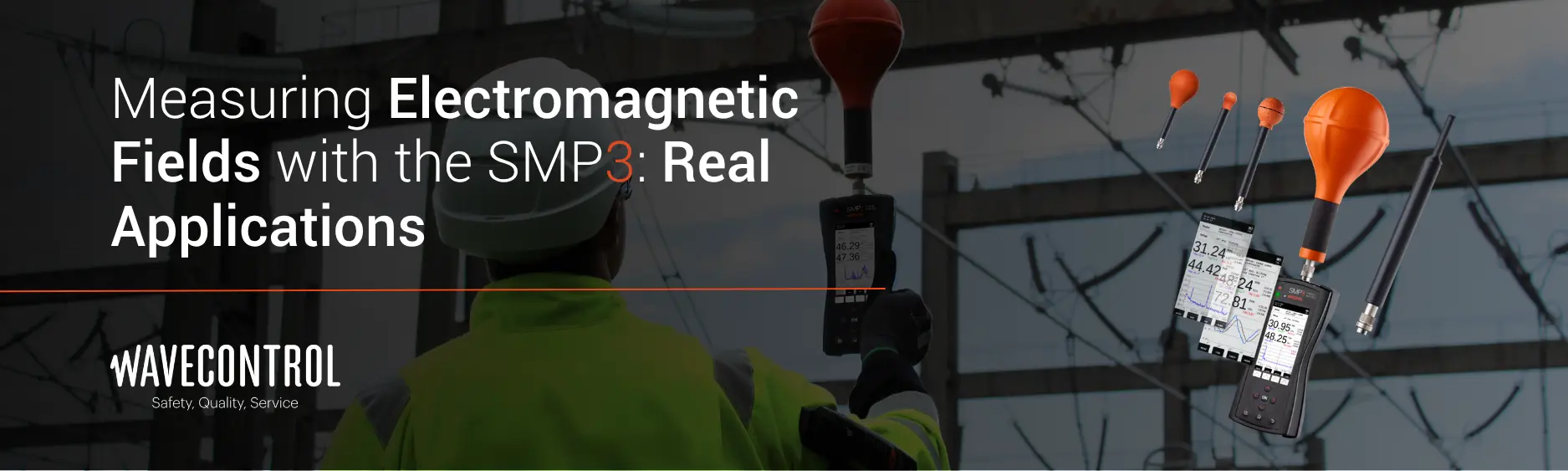
Exposure to non-ionizing electromagnetic fields (EMF) requires precise assessment to guarantee occupational and public safety. The portable SMP3 EMF Meter offers a comprehensive solution, covering a wide frequency range: from DC up to 90 GHz. This article explores the SMP3’s capabilities to address measurement challenges and ensure compliance with international regulations, including ICNIRP and IEC series standards. It analyzes how this technology facilitates regulatory compliance across various sectors.
Fundamentals of Electromagnetic Fields and Safety Standards
Exposure to non-ionizing electromagnetic radiation requires a clear understanding of the main interaction mechanisms. These are classified into two major groups: non-thermal effects and thermal effects.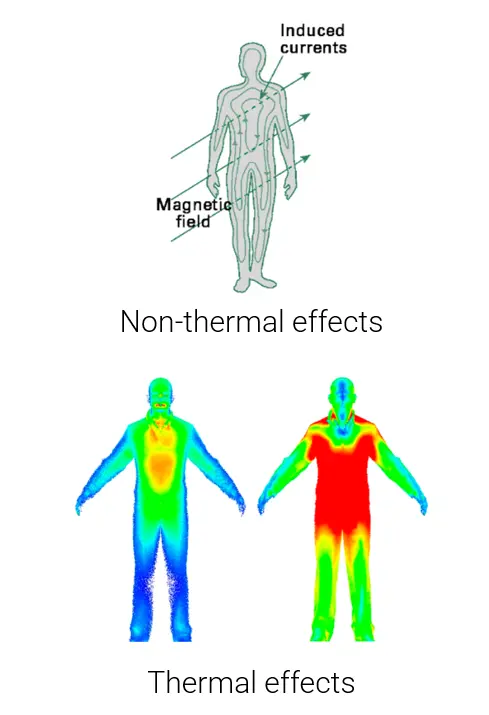
- Non-Thermal Effects (1 Hz to 10 MHz): Non-thermal effects occur from 1 Hz to 10 MHz and are mainly associated with electrostimulation of nerves and muscles. These effects can be direct or indirect and are especially relevant for users of active implanted medical devices, who are subject to specific limits. In complex field environments, the weighted peak method is preferred, as it considers both amplitude and phase of spectral components, allowing direct comparison with exposure limits.
- Thermal Effects (100 kHz to 300 GHz): Thermal effects occur between 100 kHz and 300 GHz and are linked to energy absorption and temperature increase. Above approximately 6 GHz, absorption becomes more superficial, concentrating on skin and dermal layers. However, heat can be transported through vascular networks, potentially increasing core body temperature. For this reason, time-averaged measurements remain the reference approach for high-frequency assessments.
There’s an overlap region from 100 kHz to 10 MHz in which both effects may occur simultaneously. When working within this bandwidth, evaluation must consider limits for both effects.
Standards addressing this issue are divided into two categories: emission standards (product standards) and exposure standards.
- Emission standards limit the EMF emitted by a device, specifying measurement procedures. Organizations like FCC or IEC publish these standards.
- Exposure standards set limits to protect people from overexposure. Organizations such as ICNIRP or IEEE publish these standards.
Exposure limits are defined for two main groups: Occupational Exposure (trained personnel in controlled environments) and General Public (with an extra safety factor, covering individuals with implanted medical devices).
The Portable SMP3 Meter: A Comprehensive EMF Measurement Solution
The SMP3 is presented as a complete solution for electromagnetic field measurement, compatible with all Wavecontrol field probes, covering a range from static fields (DC) up to 90 GHz.
Its key features assist in ensuring compliance with international standards:
- Broad Measurement Capabilities: Measures static magnetic fields, performs FFT analysis and weighted peak measurements up to 10 MHz, plus broadband measurements up to 90 GHz.
- Regulatory Compliance: Meets low-frequency standards such as IEC 61786-1 and high-frequency standards such as IEC 62232. Includes multiple built-in exposure limits for easy evaluation.
- Specialized Probes: Includes the WPH DC probe (DC up to 40 kHz), intended for DC magnetic field, and WP series probes (up to 10 MHz) allowing measurement of both electric and magnetic fields in a single unit. For high frequency, WPF probes (up to 90 GHz) and WPH probes (up to 1 GHz) are used.
- Operational Features: Automatic probe recognition, graphical display of field evolution, calibration expiry alerts, simplified spatial averaging, and programmable measurements. Furthermore, its firmware can be easily updated to incorporate the latest regulatory changes.
The device is complemented with the SMP software, enabling remote control, data visualization, and automatic report export in Excel format.
Practical Cases: Electromagnetic Field Assessment in Key Sectors
The versatility of the SMP3 allows its use across multiple industries requiring EMF measurement:

Energy Sector: Focuses on low-frequency fields (50/60 Hz and harmonics) generated by high-voltage lines, buried cables, and substations. The main standard in this application is IEC 62110. In non-uniform fields, spatial averaging is required, measuring at different heights. Tripods and fiber optic cables are recommended to eliminate operator interference.

Railway Sector: This is a critical area for public safety. Magnetic fields (DC up to 20 kHz) from infrastructure, rolling stock, and traction systems are evaluated. The solution combines WPH DC and WP series probes, using the 20 kHz bandwidth function to ensure compliance.

Appliances and Residential: IEC 62233 covers magnetic fields from 10 Hz to 400 kHz in devices with motors, heating elements, electronic circuits, and induction systems. Measurements are taken at contact distance for small appliances, or 30 cm for larger ones. For induction cooktops, measurements are taken at 30 cm and four specific points.

Automotive (Electric Vehicles): Increasing requirements for low-frequency magnetic fields (DC to 20 kHz) inside and outside vehicles, as well as in components, due to the development of EV industry. The main international standard in this application is IEC 62764.

Welding Sector: Assessment of low-frequency magnetic fields (up to 10 MHz) due to very high currents.
Conclusion
The portable SMP3 meter stands out as a versatile and powerful tool for EMF measurement across all sectors. Its ability to cover a range from DC to 90 GHz and strict compliance with international standards ensures precise and reliable assessment. This device provides the necessary functionalities for high-level electromagnetic safety management. We recommend incorporating this technology to raise electromagnetic safety standards in your organization.
If you would like further details on how the SMP3 operates or guidance on its use in different measurement scenarios, you are welcome to contact one of our experts. Our team will be glad to provide additional technical information or answer any questions regarding this solution.
Article-related FAQ
What differentiates emission standards from exposure standards for electromagnetic fields?
Emission standards (product standards) limit the EMF emitted by a device in a particular environment, specifying measurement procedures. Exposure standards limit the amount of EMF a person can receive to avoid overexposure, being more restrictive for the general public.
What measurement methods are used to evaluate non-thermal EMF effects?
Non-thermal effects, occurring at low frequencies (1 Hz to 10 MHz) and causing nerve stimulation, are evaluated through weighted peak (or RMS) measurements which allow direct comparison with international regulatory limits. FFT analysis can also be used.
How does the SMP3 ensure probe calibration?
Wavecontrol’s SMP3 includes an alert system that notifies the user when a probe’s calibration is about to expire (recommended recalibration every 24 months) or has already expired. This ensures measurements are always performed with maximum precision and traceability.
Is the SMP3 suitable for measuring both low and high-frequency fields?
Yes, the SMP3 meter is compatible with probes covering a wide spectrum, from static fields (DC) up to 90 GHz. WP series probes are used for low frequency (up to 10 MHz), while WPF or WPH probes are used for radiofrequency applications (up to 90 GHz).
What procedure is recommended for measuring EMF in electrical substations?
In the energy sector, IEC 62110 is used. For non-uniform fields, spatial averaging is applied, measuring at different heights to obtain the average. Fiber optic cables are recommended to avoid operator interference during measurement.
How have ICNIRP exposure guidelines evolved in recent years?
ICNIRP guidelines have been updated to reflect improved scientific understanding. The 2010 guidelines replaced earlier limits for low-frequency exposure, while the 2020 guidelines updated high-frequency limits, including changes in averaging time from 6 to 30 minutes in certain ranges. Many national regulations are progressively adopting these revisions.

Project supported by ACCIÓ"s International Promotion Programme

Follow